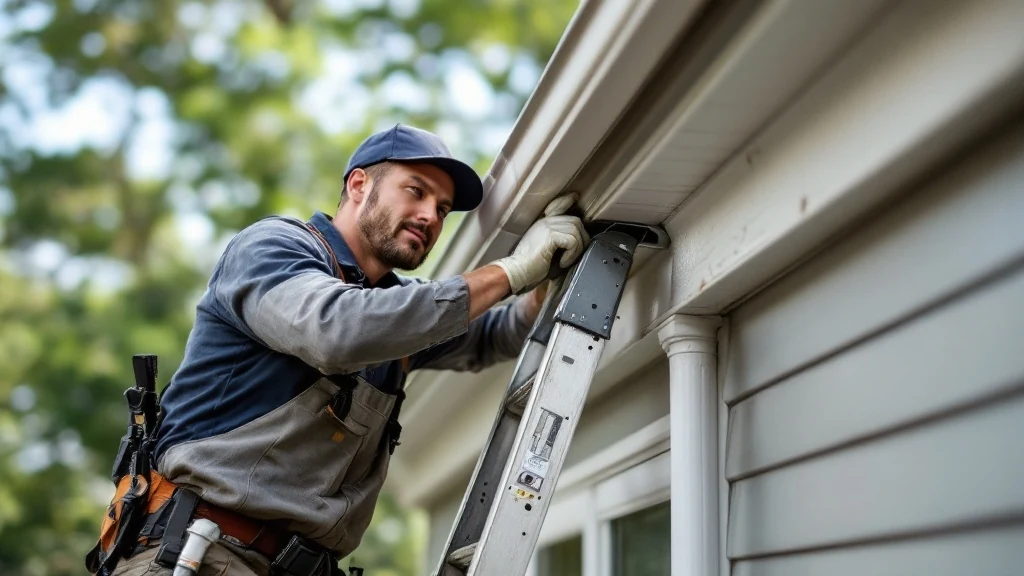
If your gutter has a visible dip in the middle of a run, water is pooling there instead of draining, and the extra weight of that standing water is pulling the hangers further out of the fascia every time it rains. Sagging gets worse on its own. It never settles.
The tricky part is that a gutter can be badly out of pitch and still look straight from thirty feet away. Aluminum bends slowly and your eye adjusts to it. So instead of trusting the glance from the driveway, run through the checks below.
Run this self-check
Four of these take under a minute. The last one needs a ladder, so leave it alone if you are not steady on one, and let us take a look instead.
- Sight down the run. Stand at one end of the gutter and look along its length like you are sighting a rifle. The top edge should read as a straight line. Any belly or wave is a section that has dropped.
- Check the gap at the back. Where the gutter meets the fascia there should be no daylight. A visible gap means the hangers have pulled and water is running behind the trough and down the wood.
- Look for water lines after a dry week. A dark tide mark or a ring of silt sitting in one part of the trough tells you water stopped there instead of moving.
- Watch the spill point in rain. Water going over the edge at the middle of a run rather than at a corner is a pitch problem, not a clog.
- Push up gently on the low spot. If it lifts easily and the hanger moves with it, the fastener has lost its grip in the fascia board.
Five causes, and how to tell them apart
Sagging is a symptom with several possible sources. Which one you have decides whether this is a sixty-dollar fix or the start of a wood repair.
| What is happening | What you see | What it takes to fix |
|---|---|---|
| Debris weight | A dip in the middle of a long run, trough packed with wet leaves or pine straw | Clear and flush the run, then reset the affected hangers. Often the whole job. |
| Hanger spacing or failure | The gutter dips between two widely separated hangers, or a spike has backed out | Add hangers at closer intervals and replace any that pulled. Inexpensive per foot. |
| Soft or rotted fascia | The screw turns without biting, wood behind the gutter is dark, spongy, or flaking paint | The board has to be repaired or replaced before anything will hold. This is the expensive branch. |
| Lost pitch | No dip you can see, but water stands in one spot and drains slowly toward the outlet | Re-hang the section to the correct fall. No new materials in most cases. |
| Ladder or storm damage | A localized dent or kink, usually near where someone set a ladder against the gutter | Reshape or replace that section. Never rest a ladder on the gutter itself. |
A gutter that sags is not a cosmetic problem. It is a gutter that has stopped moving water, sitting directly above the wood it is bolted to.
Why pitch matters more than it looks
Gutters are not hung level. They are hung with a deliberate fall toward the downspout so gravity does the work, and the installation standard is a minimum drop of about a quarter inch for every ten feet of run (National Gutter Authority (NAHB guideline)). On long runs, or in a place that gets this much rain, some installers go steeper, up to three eighths or half an inch per ten feet.
That is a small number. Which is the whole point: it does not take much sag to erase it. A section that drops half an inch in the middle has not just lost its fall, it has reversed it, and water now runs away from the outlet and stops. Once it stops, it sits, and a foot of standing water in a five-inch trough is heavy enough to keep pulling.
What it costs to put right
Re-hanging and re-pitching a sagging section typically runs about $150 to $500, or roughly $85 to $250 for a straightforward slope adjustment (SquareDash (2026)). That is usually a flat service fee rather than a price by the foot, because the labor is in the diagnosis and the resetting, not in the length.
The number that should worry you is the one behind it. If the sag has been there long enough that water has been running down the fascia, repairing rotted fascia and soffit commonly runs $900 to $6,800 (This Old House (2026)). The gap between those two figures is the entire argument for dealing with a dip while it is still a dip.
What a sag does to everything under it
Follow the water. A section that holds instead of drains has to put that volume somewhere, and it goes over the front lip in a sheet at the low point. That is a concentrated stream landing on one strip of ground, storm after storm, in a city that averages more than sixty inches of rain a year (NOAA / U.S. Climate Data).
Directly below is usually a flower bed, then the slab. Our clay soil swells when it is saturated and shrinks back when it dries out, and that swelling and shrinking under one corner of a house is what moves concrete. Foundation repair from water-driven settlement averages around $5,100 (This Old House / Angi (2026)).
Meanwhile the trough itself is holding standing water for days, which is a mosquito nursery: eggs reach adults in as little as four days in warm weather (CDC / EPA guidance). So a dip you can barely see from the yard is running three problems at once, and the gutter is the cheapest of the three to deal with.
How long can you leave a sagging gutter?
It can wait a few weeks if
- A slight dip, and the gutter still drains after rain stops
- Sound fascia behind it, paint intact and no dark staining
- A packed trough, with the sag showing up along with the debris
- It is one short section, not the whole side of the house
Deal with it now if
- Water stands in the trough for days after a storm
- There is daylight between the gutter and the fascia board
- Wood behind the gutter is soft, dark, or shedding paint
- A hanger has already pulled free and the section is hanging on the others
What we do about it
We start by finding out whether the fascia will hold a fastener, because everything else depends on that answer. If the wood is sound, we clear the run, reset the hangers at the right spacing, and re-pitch the section so it falls toward the outlet again. Then we flush it with water and watch where it goes, which is the only way to confirm a pitch correction worked.
If the board is gone, we tell you that before we do anything else, because hanging a gutter on rotted wood is a repair that fails again in a season. Either way you hear what we found and what it will take, with no work starting until you say so.
Sources
Related gutter services in Baton Rouge
Need gutter cleaning in Baton Rouge? Get a free estimate today.
📞 225-529-1427