It rained hard last night, and this morning there is a trench dug into the mulch at one corner of the house. The gutter looks clean from the driveway. So why is all that water landing in one spot?
Because the gutter is probably fine and the downspout is not. A clogged downspout is the failure people misdiagnose most, since the trough itself can be spotless while the vertical pipe below it is packed solid with the debris that washed down into it. Every gallon that lands on that side of the roof arrives at one blocked outlet and then goes over the edge.
Symptoms, from obvious to easy to miss
- Water spilling over the gutter right at the corner where the downspout is, while the rest of the run stays dry.
- Nothing coming out of the bottom of the downspout during a steady rain.
- A hollow, high-pitched trickle instead of the usual rush when water is moving through it.
- A visible bulge or a seam pulling open partway down the pipe, which is packed debris pushing the sheet metal apart.
- A trench, eroded mulch, or a bare patch in the grass directly under the eave near that corner.
- Staining or a mud band on the siding within a foot or two of the ground on that wall.
- Mosquitoes hanging around that corner of the house on a dry week, which means water is sitting in the pipe or the elbow.
Run this five-minute test from the ground
You do not need a ladder to confirm it. You need a garden hose and a few minutes on a dry day.
- Knock on the pipe. Start at the top and work down, rapping it with your knuckles every foot or so. An empty downspout rings hollow. Where the sound goes flat and dull, that is where the packed debris starts. Most of the time you will find it right at the top elbow or at the bottom bend.
- Look up into the bottom opening. Point a phone light up the outlet at ground level. If you can see daylight up the pipe, the lower half is clear and the problem is higher. If you see a wall of black sludge, you have found it.
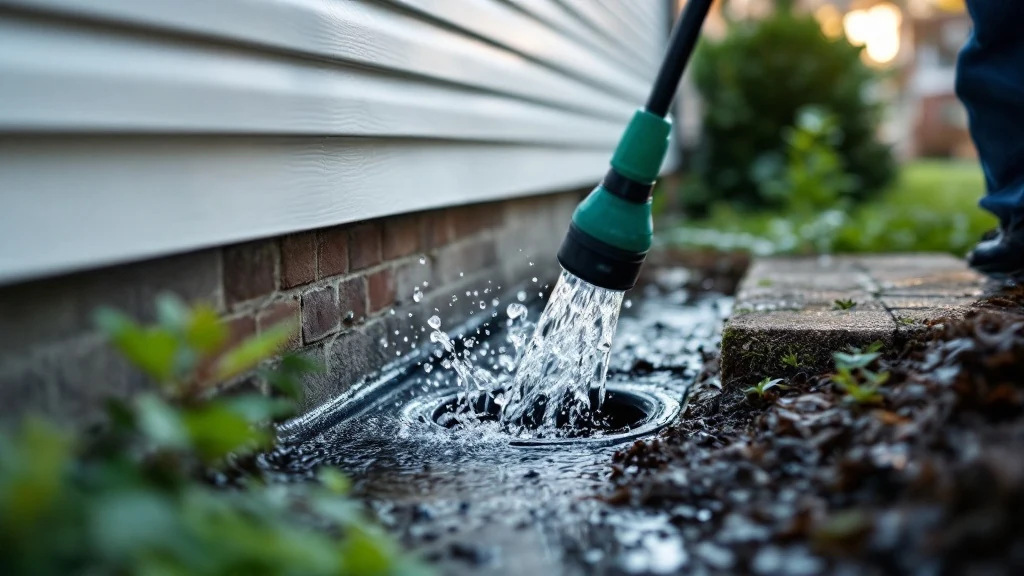
- Run the hose into the top of the downspout. Feed the hose into the outlet where the gutter meets the pipe and turn it on full. Water should come out the bottom within a couple of seconds and keep pace with what you are putting in.
- Watch what backs up. If water rises in the gutter around the outlet, the blockage is right at the drop. If the pipe fills but only dribbles out the bottom, it is stuck in the lower elbow, which is the most common spot because that bend is where everything comes to rest.
- Check where the water goes when it does come out. A clear downspout that dumps against the slab has traded one problem for another. The outlet should carry water at least four to six feet away from the house, on a downhill run.
Where does the clog usually sit?
At the top drop outlet
- Whole leaves and pine straw jam the opening as water pulls them toward it
- Shows up as the gutter overflowing at the corner while the pipe below stays bone dry
- Often clears with a hand scoop plus a flush from above
- Comes back fast if the trough is still full of debris feeding it
In the bottom elbow
- Grit, shingle granules, and rotted sludge settle in the bend and set like packed sand
- Shows up as a slow trickle out the bottom and a bulging seam above it
- Usually needs the elbow taken apart or a snake run up from below
- Standing water in that bend is where the mosquitoes are coming from
What it takes to clear, and what that runs
On most homes this is a small job. A gutter and downspout cleaning generally runs about $100 to $250, with roughly $60 to $150 on top of that to flush a heavily clogged downspout (HomeGuide (2026)). If the pipe cracked or a seam split from the pressure of the packed debris, a downspout repair itself averages about $75 to $180 including parts and labor (HomeGuide (2026)).
Compare that against what the overflow is doing while you decide. Water pouring in one concentrated spot next to the slab is the exact pattern that drives settlement in our clay soil, and foundation repair from water-driven settlement averages around $5,100 (This Old House / Angi (2026)). The pipe is the cheap part of this equation by a wide margin.
Why downspouts clog faster in Baton Rouge
A downspout is a funnel. Everything that lands on that whole plane of roof gets narrowed down into a pipe three by four inches wide, and whatever floats gets carried straight to it. In a dry climate that pipe sees a few weeks of leaf traffic a year. Here it sees water almost constantly, since more than sixty inches of rain falls in an average year (NOAA / U.S. Climate Data) and the heaviest months run June through August (weather-and-climate.com (1990-2020)).
Volume is only half of it. The other half is what our trees drop. Pine straw is the worst offender in a downspout because the needles bridge across the opening and knit into a mat that water pushes tighter rather than clearing. Water oak catkins do something similar in spring, and sweetgum balls and crape myrtle seed pods are almost exactly the wrong size, big enough to wedge in an elbow and small enough to get there.
Then summer heat bakes what is trapped. A few cycles of soaking and drying turn loose debris into a dense plug that behaves more like packed clay than like leaves, which is why a shop vac at the bottom often does nothing at all.
When it is not the downspout at all
Two other things produce the same symptom, and both are worth ruling out before you spend money on the wrong fix. The first is slope. Gutters are hung with a deliberate fall of about a quarter inch for every ten feet of run so water is pulled toward the outlet (National Gutter Authority (NAHB guideline)). If a section has sagged out of pitch, water pools at the low point and never reaches a downspout that is perfectly clear.
The second is capacity. A single downspout serving a long run of roof on a house with heavy tree cover can be undersized for the way it rains here. If the pipe flows freely and the gutter still backs up in a hard storm, the answer is another outlet, not another cleaning.
When to call us
Get in touch if any of these describe your situation. We clear the trough and flush every downspout until it runs clean at the bottom, and we check the pitch while we are up there:
- Your hose test backs up and you cannot reach the blockage from the ground.
- A seam has separated, or the pipe is bulging under the pressure.
- It is a second-story downspout, which puts you on a tall ladder at a bad angle.
- It clogged again within a few months, which usually means the gutter above it was never cleared properly.
Sources
Related gutter services in Baton Rouge
Need gutter cleaning in Baton Rouge? Get a free estimate today.
📞 225-529-1427