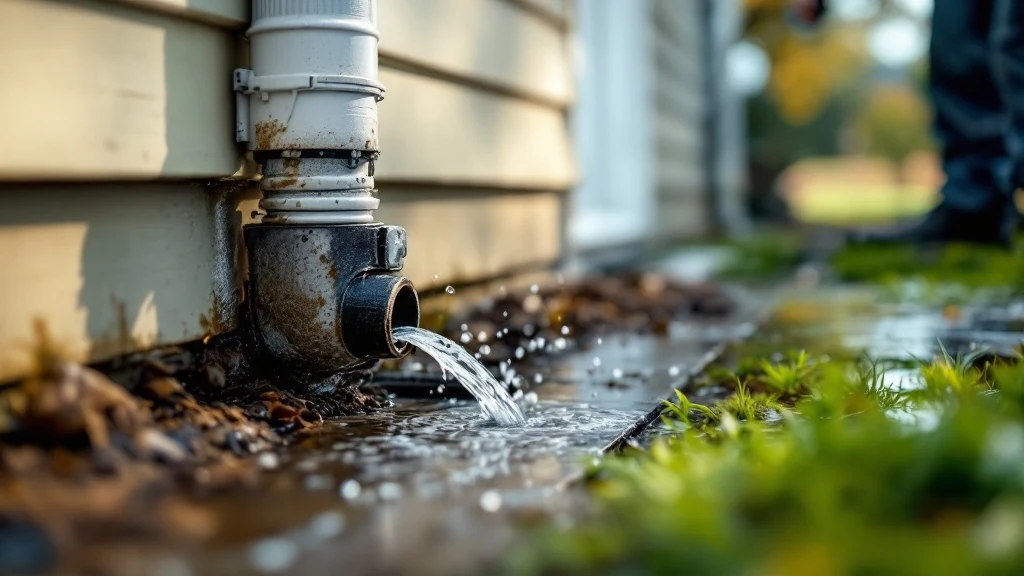
Stand under an eave in a hard Baton Rouge rain and listen. That roar inside the pipe at the corner of the house is the sound of a few hundred gallons an hour being handed from a wide, slow channel into a narrow, fast one. Everything about how downspouts work, and how they fail, follows from that handoff.
The trough gets the attention because it is the part you can see filling with leaves. But the trough is only a holding lane. The downspout is what moves the water, and it is where most of the failures live.
Follow one gallon from roof to yard
- It sheets off the shingles. Water does not fall off a roof in drops. It runs down the plane as a thin sheet, picks up speed on the way, and comes off the drip edge with enough momentum that a gutter set too low or too far out will let it fly straight past into the yard.
- It runs sideways along the fall. In the trough, gravity takes over on a deliberate slope of about a quarter inch per ten feet of run (National Gutter Authority (NAHB guideline)). That gentle tilt is the only thing pulling the water toward the corner. The trough is not storage, it is a ramp with a lip.
- It funnels into the drop outlet. At the corner, everything that fell on that whole plane of roof narrows into a hole a few inches across. This is the bottleneck of the entire system, and whatever floats gets delivered right to it by the same current carrying the water.
- It accelerates down the stack. Inside the vertical pipe, water is in free fall against the walls, which is why a downspout can handle so much more volume than its cross-section suggests. It is also why a partial blockage makes such a distinctive hollow, high trickle instead of a rush.
- It turns at the bottom elbow. The bend at ground level slows the flow abruptly. Anything heavy that made it this far, grit, shingle granules, a sweetgum ball, settles here. This bend is the most common place a downspout packs solid.
- It gets discharged, or it does not. The last few feet decide whether the whole system helped. Discharge should travel four to six feet away from the wall, on a downhill run. Dumped at the slab, that water goes straight into the soil the foundation is sitting on.
Why they back up
Four causes cover nearly every backed-up downspout, and telling them apart from the ground saves you a wasted afternoon working on the wrong one.
| Cause | How it shows up | What it takes |
|---|---|---|
| Debris at the drop outlet | The gutter overflows at the corner while the pipe below stays dry and rings hollow. | Clear the trough and the outlet by hand, then flush from above until it runs clean. |
| A plug in the bottom elbow | A slow trickle out the bottom in a downpour, a dull thud when you knock on the bend, sometimes a bulging seam. | Take the elbow apart or snake it from below. A shop vac rarely moves packed sludge. |
| Not enough downspouts for the roof | The pipe flows freely and the gutter still backs up, but only in the hardest storms. | Add an outlet. More cleaning will not fix a capacity problem. |
| Lost pitch upstream | Water stands in the middle of a run and never reaches a downspout that tests perfectly clear. | Re-hang and re-pitch the section, roughly $85 to $250 for a slope adjustment (SquareDash (2026)). |
Why our climate is hard on the pipe
More than sixty inches of rain falls here in an average year, roughly double the national figure (NOAA / U.S. Climate Data), and the heaviest months run June through August (weather-and-climate.com (1990-2020)). That is a lot of trips through the same narrow bend.
The debris is the other half. Pine needles bridge across a drop outlet and knit into a mat that water pressure only packs tighter. Water oak catkins do the same thing in spring. Then summer heat bakes what is trapped in the elbow through cycles of soaking and drying until it sets, which is why a plug that has been there since June does not move for a garden hose in September.
What a bad discharge point costs
A perfectly clear downspout that empties against the slab is still a problem, and it is the one homeowners are least likely to notice, because there is no overflow to see. The water just arrives where it should not.
Our clay soil swells when it is saturated and shrinks as it dries out. Concentrating a roof's worth of runoff into one strip of soil beside the house drives that cycle harder there than anywhere else in the yard, and uneven movement under a slab is what cracks it. Foundation repair from water-driven settlement averages around $5,100 (This Old House / Angi (2026)). An extension costs about as much as lunch.
Buried drains: the version you cannot inspect
Plenty of Baton Rouge homes route the downspout into a pipe that disappears into the ground and surfaces somewhere out in the yard, or ties into a drain at the curb. When it works, it is the best possible discharge, since the water comes out well clear of the house.
When it stops working, you get no warning at all. Roots find the joints. Silt settles in the horizontal run and never washes out because there is no fall to speak of. The far end gets buried under sod or crushed by a mower over the years. From above everything looks fine right up until the downspout starts backing up in every storm, and by then the buried line is full end to end.
The tell is a downspout that tests clear along its visible length but still backs up at the bottom elbow. Before anyone digs, it is worth confirming the water is even reaching daylight: run a hose into the drain and go find the outlet in the yard. If nothing comes out, the problem is under the grass, not in the pipe on the wall.
Maintenance that matters
- Flush each downspout with a hose at least twice a year, and always after the last big leaf drop.
- Knock on the pipe from top to bottom in spring. A dull section is a plug forming.
- Keep four to six feet of extension on every outlet, aimed downhill and away from the wall.
- Check the elbows after a storm season. That bend collects first and empties last.
- Watch for a bulge or an opening seam, which means packed debris is pushing the metal apart.
If a downspout is stuck and the hose test backs up on you, or it is a second-story run, call us. We clear the trough that is feeding it, flush every pipe until it runs clean at the bottom, and check where the discharge lands before we call the job done.
Sources
Related gutter services in Baton Rouge
Need gutter cleaning in Baton Rouge? Get a free estimate today.
📞 225-529-1427