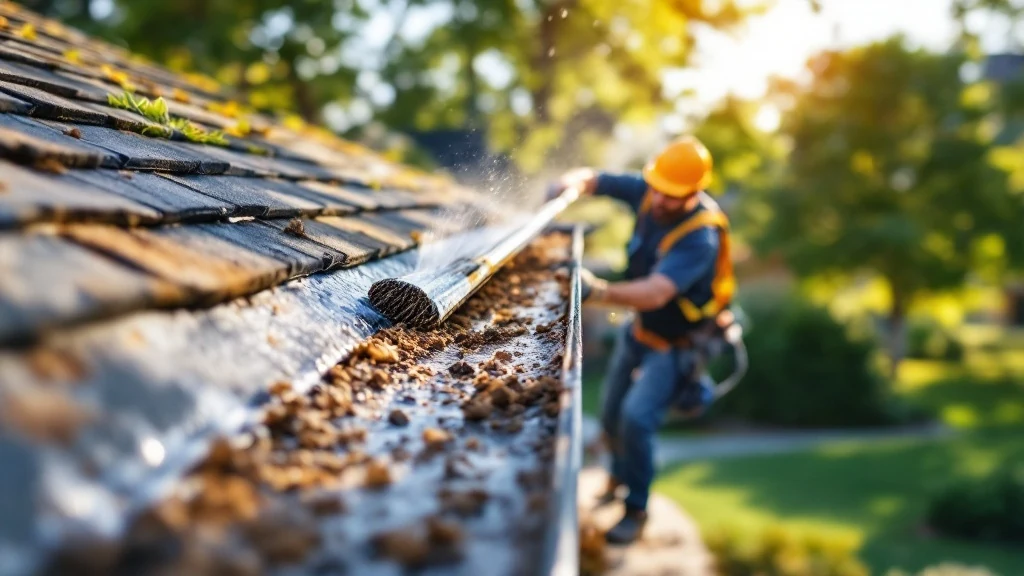
About 500,000 people are treated for ladder-related injuries in the United States every year, and roughly 300 of those falls are fatal (AAOS / CPSC, via ANSI). Gutter work puts you on a ladder, at height, doing something with both hands, next to a hard surface. That is the whole safety question in one sentence.
Which does not mean nobody should ever clean their own gutters. Plenty of people do it safely for years. It means the risk is concentrated in a few specific situations, and knowing which ones apply to your house is worth more than any general advice about being careful.
Where the danger comes from
Falls from gutter work rarely start with the ladder collapsing. They start with a small decision that seemed reasonable at the time.
- Overreaching. The single biggest cause. The last two feet of a run are annoying to reach, moving the ladder takes thirty seconds, and your belt buckle drifts past the side rail.
- Soft or sloped footing. Wet Baton Rouge soil, a flower bed, or a driveway apron with a crown will all let a ladder foot walk sideways under load.
- Leaning the ladder on the gutter. Aluminum dents and hangers pull. The ladder shifts as the trough gives, which is exactly when you are holding a bucket.
- Working with both hands full. Scoop in one hand, bucket in the other, and there is nothing left to catch yourself with.
- Wet everything. Wet leaves are slick, wet rungs are slicker, and the debris coming out of a gutter here is always wet.
- Getting on the roof to reach the gutter. A roof edge with algae or morning dew is the least forgiving surface on your property.
- Power lines at the corner. The service drop usually enters near an eave, and an aluminum ladder does not need to touch a line to be a problem.
Sort your own house into one of three buckets
Reasonable to do yourself
Single-story, gutters reachable from a fiberglass ladder on flat, firm ground, a helper at the base, and you are steady at height. Work in short sessions, move the ladder often, and stop when you get tired.
Think hard about it
A story and a half, a steep grade or soft beds along the wall, no helper available, or several years of buildup that means heavy, awkward loads. The job is doable and the margin is thin.
Do not get on the ladder
Two or more stories, a roof you would have to walk, any dizziness or balance issue, a service drop near the eave, or you would be working alone with nobody expecting you. Call us instead.
If you are doing it yourself, do it this way
- Use a fiberglass extension ladder, not the aluminum one in the garage. Fiberglass does not conduct, which matters near a service drop. Set it at roughly a four-to-one angle: one foot out from the wall for every four feet of height.
- Add a stabilizer bar. It is an inexpensive attachment that spans the ladder off the wall or the roof edge, so the load never rests on the gutter. It also widens the contact points, which is what stops the sideways walk.
- Never let your belt buckle pass the side rails. That is the whole rule for reach. When the next section is out of range, climb down and move the ladder. Every time. This one habit prevents most gutter falls.
- Keep one hand on the ladder. Hang the bucket from a hook on a rung instead of holding it. Use a scoop, not your fingers, because gutters collect screws, roofing nails, and sharp aluminum edges.
- Have somebody home. A helper footing the ladder is better. Someone inside who knows you are up there is the minimum. Do not do this while the house is empty.
- Pick a dry, cool morning. Not after rain, not in the middle of a Louisiana afternoon in July. Heat exhaustion at the top of a ladder is its own hazard.
The last two feet of a run are where people fall. Moving the ladder takes thirty seconds and the emergency room takes considerably longer.
How much does doing it yourself save?
The money deserves a straight look, since it is the reason anyone considers this. A cleaning here generally runs $70 to $200 on a single-story home and about $100 to $275 on a two-story, with the height difference driving most of that gap (HomeGuide (2026)). Nationally the average lands around $168 a visit (Angi (2026 data)).
Set against that, a decent fiberglass extension ladder plus a stabilizer runs a good fraction of one visit on its own, and the job costs you a morning two to four times a year. The savings are not nothing. They are also smaller than most people picture before they price the ladder.
Hazards that are not the ladder
Height gets all the attention, and it deserves most of it. But a gutter is a wildlife habitat and a sharp-edged metal channel, and the smaller injuries are the ones people are least prepared for.
What lives in a neglected gutter
- Wasp and hornet nests tucked under the front lip, where you cannot see them until your hand is there
- Fire ants, which will colonize a debris mat above ground level
- Rats and squirrels using a full trough as a run between the roof and a tree limb
- Mosquito larvae in any section holding standing water, which is a health issue in Louisiana
What the metal does
- Cut edges along the back of the trough are sharp enough to open a hand through a thin glove
- Roofing nails and screws collect in the bottom and are invisible under wet leaves
- Rusted spike heads snap off under load with no warning
- Aluminum gets hot enough in a Louisiana afternoon to burn a bare forearm
Heavy gloves, a scoop instead of fingers, and a look under the lip before reaching in cover most of it. So does not doing this in the heat of the day in July.
What gets missed from the top of a ladder
There is a quality gap as well as a safety one. From a ladder you can reach into the trough, but you cannot see along it. Flushing the downspouts is the step that most often gets left out of a do-it-yourself cleaning, and a spotless gutter feeding a packed downspout still overflows in the next storm.
The pitch check goes the same way. Gutters hang on a deliberate fall of about a quarter inch per ten feet of run (National Gutter Authority (NAHB guideline)), and confirming a section still holds that means putting water through it and watching where it goes, not looking at it. So does inspecting the fascia behind the gutter for soft wood, which is where the expensive damage starts.
When to call us
We do this every day, with the ladders and the footing gear for it, and we carry the insurance so the risk is not sitting on you. Get in touch if any of these describe your house:
- Your gutters are on a second story or above.
- Ground along the wall is soft, sloped, or planted.
- There is a power service drop near the eave you would be working under.
- You are not comfortable at height, or you would be up there alone.
- It has been long enough that the trough is heavy, sagging, or growing something.
Sources
Related gutter services in Baton Rouge
Need gutter cleaning in Baton Rouge? Get a free estimate today.
📞 225-529-1427