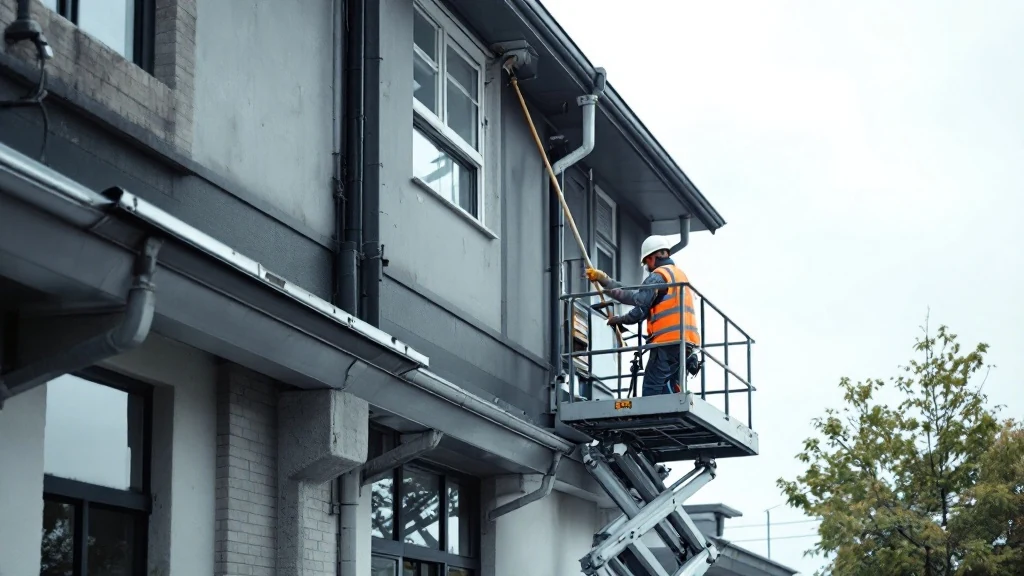
On a commercial property, gutter maintenance is not a curb-appeal item. It is water management for a roof that may be several times the area of a house, feeding into a drainage system with fewer outlets per square foot, above an entrance where people walk.
The failure modes are different too. A residential clog costs a homeowner a fascia board. A commercial clog puts water across a walkway, into a tenant space, or onto stock. That changes how the schedule should be built and who needs to sign off on it.
Why do commercial gutters clog faster?
Three things separate a commercial roofline from a house, and each one shortens the safe interval between visits.
- Surface area per outlet. Large low-slope roofs deliver a great deal of water to relatively few drains and downspouts, so a single blockage takes a bigger share of the system offline.
- Debris nobody planted. Parking-lot litter, packaging, roof gravel, HVAC condensate scale, and bird nesting material all end up in commercial gutters alongside the usual leaf load.
- Rooftop equipment. Units, curbs, and screens create dead zones where debris piles up and stays, and service technicians walking the roof move it around.
- Access constraints. Work often has to happen outside business hours, which is a scheduling factor, not a technical one, but it belongs in the plan.
- Liability exposure. Overflow above a doorway or a walkway is a slip hazard with a different set of consequences than a wet flower bed.
Layer our climate on top of that. Baton Rouge averages more than sixty inches of rain a year, roughly double the national figure (NOAA / U.S. Climate Data), with the heaviest months running June through August (weather-and-climate.com (1990-2020)). A drainage system that is 80 percent clear is fine in a drizzle and inadequate in a July downpour.
A schedule you can put in a budget
| Property type | Recommended frequency | What drives it |
|---|---|---|
| Retail strip center with tree cover | Quarterly | Parking-lot landscaping, customer walkways under the eave line, and multiple tenants who each notice a leak. |
| Office building, mature landscaping | Three times a year | Heavy spring and fall drop, plus a pre-storm-season clearing. |
| Warehouse or light industrial, open site | Twice a year | Less organic debris, but long runs and few outlets mean a single blockage matters more. |
| Restaurant or food service | Quarterly | Grease-laden exhaust residue combines with debris into a mat that does not rinse out. |
| Multi-family and apartments | Quarterly | Resident-facing walkways, high complaint sensitivity, and heavy tree cover on most sites. |
| Medical or professional with covered entries | Quarterly | Overflow lands where patients and clients walk. The tolerance for it is close to zero. |
| Any property with mature pines on site | Quarterly | Pine sheds nearly year-round and the needles mat into a felt that water cannot pass through. |
What a commercial visit covers
- Site walk and documentation. We walk the perimeter first and note overflow evidence, staining, and any spot where discharge is landing on a walkway or against the building. That walk becomes the record for the visit.
- Clear all runs by hand. Debris is bagged and removed rather than blown across the roof or into the lot. On commercial roofs, blowing debris relocates the problem to a drain you cannot see from the ground.
- Clear and flush every outlet and downspout. Each pipe gets water pushed through it until it runs clean and keeps pace at the bottom. On a large roof this is the step that finds the blockages nobody knew about.
- Inspect hangers, seams, and fall. Long commercial runs are more sensitive to pitch than residential ones, and the standard is a minimum drop of about a quarter inch per ten feet of run (National Gutter Authority (NAHB guideline)).
- Check discharge points and splash zones. Where the water lands matters as much as whether it moves. Discharge onto a walkway, into a planter against the slab, or toward a loading dock all get flagged.
- Written report with photos. You get a record of what was cleared, what was found, and what needs attention, which is what makes this budgetable rather than reactive.
Why a fixed schedule beats reacting
Reactive maintenance on a commercial property is expensive in ways that do not show up on the gutter invoice. Water that gets into the building interrupts a tenant. Water on a walkway is a liability claim waiting for the right pedestrian. Water against the foundation is the same problem houses have, at a larger scale: our expansive clay swells when saturated and shrinks as it dries, and foundation repair from water-driven settlement averages around $5,100 (This Old House / Angi (2026)) on a residential scale alone.
Above the wall line, overflow running down the fascia rots the wood and the soffit behind it. Repairing rotted fascia and soffit commonly runs $900 to $6,800 (This Old House (2026)) on a house, and commercial runs are longer. None of that is on the schedule until it is an emergency, which is the argument for putting the small recurring cost on the calendar instead.
A maintenance line item is a number you choose. A water intrusion is a number that chooses you.
Budgeting it
Commercial work is quoted per property rather than off a price list, because the drivers are roofline length, height, access, number of outlets, and how much equipment is up there. For reference on scale, residential cleaning is commonly priced at $0.95 to $2.25 per linear foot (Angi (2026 data)), running higher with height. Commercial pricing starts from the same logic and then accounts for access, safety requirements, and after-hours scheduling.
What makes the number predictable is the contract. An annual agreement with a fixed number of visits gives you a line item that does not move, and it removes the pattern where nothing happens until a tenant calls about a ceiling stain.
What you get from us
On every visit
- All runs cleared by hand and debris removed from the site
- Every downspout and outlet flushed and confirmed flowing
- Hangers, seams, and fall inspected
- Discharge points checked for walkway and foundation exposure
- Photo documentation and a written summary
How we work with you
- Scheduling outside business hours where the site needs it
- A fixed annual visit count so the cost sits in your budget
- Certificate of insurance on file before the first visit
- One point of contact rather than a call center
- Findings flagged in writing, with repairs quoted separately, never assumed
If you manage property in Baton Rouge and gutter maintenance is currently happening whenever someone complains, call us. We will walk the site, tell you the interval it needs, and put a number on it you can take to a budget meeting.
Sources
Related gutter services in Baton Rouge
Need gutter cleaning in Baton Rouge? Get a free estimate today.
📞 225-529-1427